
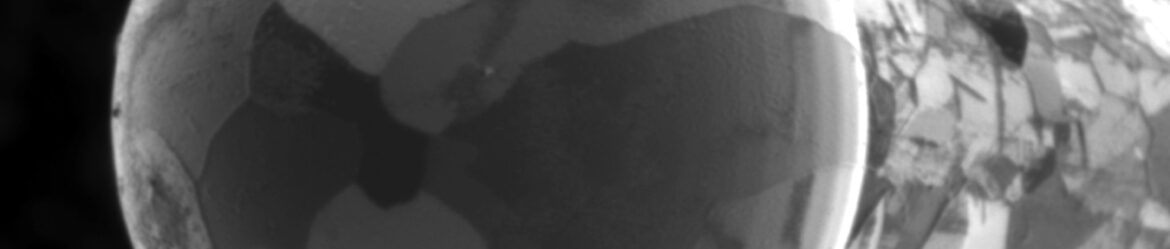
The group’s research focuses on interface thermodynamics, kinetics, and microstructural evolution in ceramics and metal–ceramic systems. Core activities include experimental and analytical studies of wetting at metal–ceramic and solid–solid interfaces using Winterbottom analysis, and applying these insights to the design and processing of ceramic matrix composites, metal–ceramic and ceramic–ceramic joints, and advanced nanocomposites. A major theme is solute adsorption at interfaces and grain boundaries, and its effect on excess interface energy, atomistic structure, grain boundary mobility, diffusion, and equilibrium crystal shape, often under controlled gas atmospheres and external fields. This work is underpinned by in-depth, correlative electron microscopy and by the development of rapid-heating routes to sintering, enabling the exploration of metastable grain boundary states, ultra-fast diffusion, and high-temperature solubility limits of dopants and impurities in ceramic materials.
News & Updates
- New paper on Separating the Influence of Calcium and Oxygen Vacancies on Grain Boundary Mobility in AluminaNew paper just published by A. Kazmirsky, R. Marder and W.D. Kaplan, Separating the Influence of Calcium and Oxygen Vacancies on Grain Boundary Mobility in Alumina, Journal of the European Ceramic Society, 118881, 2026. R.
- New paper on: Detecting and Measuring Interface Chemistry to Correlate With Interface Properties: Can Interfaces be “Clean”?K. van Benthem and W. D. Kaplan, Detecting and Measuring Interface Chemistry to Correlate With Interface Properties: Can Interfaces be “Clean”?, Journal of the American Ceramic Society, 109: e70530, 2026.
- New paper on: Ultrafast Firing Effects in Y-doped Zirconia Nanoparticles in Journal of the European Ceramic SocietyM. Biesuz, E. Martin, L. Karacasulu, T. Hérisson de Beauvoir, R. Marder, W.D. Kaplan and C. Estournès, Ultrafast firing effects in Y-doped zirconia nanoparticles: Heating rate matters even under “Conventional” conditions, Journal of the European Ceramic Society, 47: 118809, 2027.
- New paper on: Carbon and Sintering of Oxides in Journal of the European Ceramic SocietyE. Martin, L. Karacasulu, R. Chaudhary, W. D. Kaplan, R. Marder, T. Herisson de Beauvoir, C. Estournès and M. Biesuz, Carbon and sintering of oxides: Densification kinetics vary by orders of magnitude, Journal of the European Ceramic Society, 46: 118550, 2026.
- Congratulations to Xinnian Wu on her paper in Acta Materialia: The Influence of Fe on Grain Boundary Mobility in AluminaThe Influence of Fe on Grain Boundary Mobility in Alumina, published in Acta Materialia. The paper is open access, and it can be downloaded here.